1.Introduction
According to the International Council of Nurses (ICN), the advanced practice nurse (APN) has an expert knowledge base who integrates research, educa-tion, care practice, and management in a highly autonomous role.[1] The APN is prepared to be an autonomous provider, leader, and educator, yet these roles are met with demands which can stagnate their progress towards making a positive impact. Ensuring time for reflection is critical for the APN. Through reflection, the APN can create synergy between past learning and future innovation. Advancing the role of the nurse and APN comes with a commitment to core professional values and an understanding of how care practices can adapt to the environment without compromising a dutiful, holistic approach. To strengthen the foundation of nursing practice, the APN can look to nursing theory as grounded frameworks to not only remain true to nursing ethics but to also guide advanced nursing practice. Nursing theory is foundational to how the nursing profession is defined and is recommended to be re-understood as a practical tool, rather than abstract concepts linked to the nursing metaparadigm. A pragmatic algorithm titled MetaPORT is proposed to assist the APN to reflect and apply nursing theory within their unique environments. Each essential step of the MetaPORT algorithm will be presented to create a process of critical thinking for the APN to use nursing theory as a tool to address their unique practice challenges.
2.MetaPORT: Metacognition
Metacognition is an effort to enhance well-being through cognitive and emotional domains.[2] Beginning the process of MetaPORT, the APN will need to apply the acronym CUE (Calming the mind, Using reflection, and Evaluation). CUE initiates the intentional work of the APN to examine the issue from past, current, and future lenses. CUE starts with “Calming the mind”. As busy healthcare professionals, time is elusive and often APNs are handling multiple issues simultaneously. Training the mind to think with clarity provides the APN with mental regulation or opening the thought pathways to distinctively think about a specific issue/concern. In doing so, the issue or concern receives attention where systematic thought can be applied opening the intellectual doorway to solutions.
The 4-Step of Reflection (see Figure 1) include:
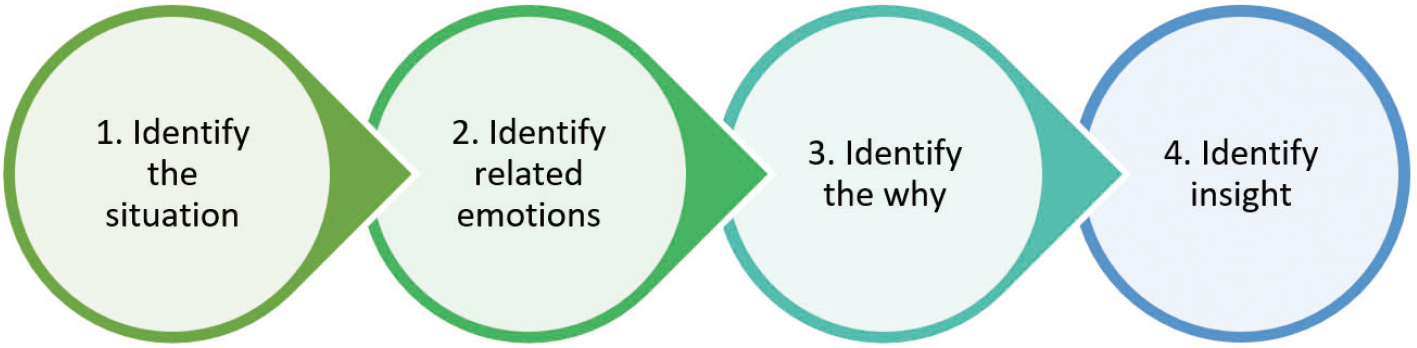
Figure 1.
4-step of reflection for the APN/student
Once reflection is complete, the APN can further the metacognitive process by engaging in the final acronym of CUE, or Evaluation. This can be done in a two-prong approach through evaluation of self and/or the situation. A common evaluation process is the SWOT analysis which identifies strengths, weaknesses, opportunities, and threats. This evaluation method requires the use of humility and unbiased responses to deliver a 4-point perspective.
3.MetaPORT: Problem identification
Throughout the evolution of the role of the nurse, the primary goal steadily remains with patient advocacy and providing safe, quality care based on evidence obtained through research. Problem identification is a critical step and one which does not present itself without metacognitive ef-forts. Often situations are embedded into daily practice and professional interactions resulting in misplaced authenticity of the concern or issue and its implications to the clinician, leader, edu-cator, patient, staff, and student. Post-metacognition, the means of identifying the situ-ation/problem is weighted on the efforts of the APN to perform due diligence regarding assessment of current evidence-based practice. An issue, concern, or even a concept related to nursing is not without connections to research. To properly identify the problem, APNs needs to engage in an integrative review of literature.
For applying nursing theory to practice, the goal is to evaluate current practices, create synergy between knowledge and experience, and to possibly identify the need for further nursing research. Using an integrative approach to review literature allows for analysis of qualitative and quantitative research through diverse sources, hence providing the APN with a comprehensive understanding to inform evidence-based practice in healthcare. APNs can use tools such as a root cause analysis (RCA) to unveil further insights into reciprocal effects stemming from the issue. As the APN gains more knowledge of factors contributing to the problem, solutions and innovative thinking become part of the MetaPORT process.
4.MetaPORT: Organize thinking
As the APN moves to the next phase of the Met-aPORT algorithm, organization of the ‘thinking’ outcomes is essential. Most often this phase of the algorithm is done through summarization. To approach this effort, a ‘thinking diary’ is suggested.
In a ‘thinking diary’ the APN can compile and sort the outcomes of the ‘Meta-cognition’ phase from how effective efforts were from calming the mind to reflection and SWOT analysis combined with results from review of literature.[3] The ‘Organize Thinking’ phase is a time where the APN can address their efforts in an individualized manner. A ‘thinking diary’ can be completed in a method which works well for the APN’s own learning styles. Options for a diary include a written notebook, computer-designed document, or an audio (visual) recording of self. A great deal of good work will be done by the APN and therefore deserves to be collected and summarized to assist the APN in filling memory gaps while highlighting important facts.
A major goal for the ‘thinking diary’ is to offer summaries of each previous phase of the algorithm. Adding any domino effects can be insightful for leading to innovative solutions. Often during a problem/issue, the effects can be lost or misinterpreted as not being impactful to the situation. These domino effects can be highlighted for future considerations. Part of the efforts in the ‘thinking diary’ are to set apart concepts, other issues/topics discovered which may provide the APN with a connection to a nursing theory/model.
5.MetaPORT: Relationship to nursing theory
Efforts by the APN up to this part of the algorithm have set the groundwork for identification, analysis, and alignment of a nursing theory or model to assist in creating solutions. Nursing theory offers more than a foundation of what it is nurses do, but it also offers a launching point for finding solutions which are evidence-based, safe, practical, and yet can still inspire future nursing contributions to healthcare, leadership, and education of its future nursing members.
Nursing theory and models are not as abstract as many of us thought. The perspective of discovering a relationship between the APN clinician, leader, and educator and nursing theory can be a welcomed process which offers the APN a sense of ‘not feeling alone’ or distanced from practicing effectively within their own specialty. Through the grounding nature of theory, APNs can look to theory to be a guiding light in a healthcare environment which is complex and ever-changing.
6.MetaPORT: Talk out loud
In the final phase of the MetaPORT algorithm, the APN engages with fellow nursing colleagues and interdisciplinary team members to adopt a ‘Community of Practice’ (CoP). This phase encourages the APN to ‘talk out loud’ about the process of finding cause/effect and possible solutions while inviting other perspectives relevant to the issue (topic). The act of engaging with others within the same professional environment opens the landscape for learning and sharing information. Knowledge is a primary source of growth for individuals as well as systems (organizations). Healthcare is persistently in a state of competition with the absolute need to be highly efficient and sustainable while not compromising quality and safety. Physicians, APNs, nurses, pharmacists, leaders, educators, therapists, and social workers, to name a few members of the healthcare environment must leverage their expertise to collaborate with other professionals to solve problems collaboratively, hence there is a strong demand for knowledge sharing.[4]
7.Conclusion
The MetaPORT algorithm is intended to provide a systematic and inclusive approach to the APNs roles while looking forward to solutions and remaining grounded in the nursing profession. Refreshing the approach to nursing theory allows the APN to continue to grow and adapt successfully to a variety of healthcare settings while embracing nursing’s core principles.
Authors contributions
Not applicable.
Funding
Not applicable.
Conflicts of Interest Disclosure
The author declares that they have no known competing financial interests or personal relationships that could have appeared to influence the work reported in this paper.
Informed consent
Obtained.
Ethics approval
The Publication Ethics Committee of the Association for Health Sciences and Education. The journal’s policies adhere to the Core Practices established by the Committee on Publication Ethics (COPE).
Provenance and peer review
Not commissioned; externally double-blind peer reviewed.
Data availability statement
The data that support the findings of this study are available on request from the corresponding author. The data are not publicly available due to privacy or ethical restrictions.
Data sharing statement
No additional data are available.
Acknowledgements
Not Applicable.
References
- International Council of Nurses. 2020 guidelines on advanced practice nursing. ICN. 2020.
- Fleur D, Bredeweg B, van den Bos W. Metacognition: ideas and insights from neuro- and educational sciences. npj Sci. Learn. 2021;6:13. doi:10.1038/s41539-021-00089-5
- Contributor P. What is a Simplified SWOT Analysis Definition in 4 Steps. PESTLE Analysis. 2021. https://pestleanalysis.com/swot-analysis-definition/
- Wu S, Wang W, Hsiao M. Knowledge sharing among healthcare practitioners: identifying the psychologi-cal and motivational facilitating factors. Frontiers in Psychology. 2021;12:736277. doi:10.3389/fpsyg.2021.736277
 This work is licensed under a

